

The interior of a ball mill is continuously subjected to impact, friction, and abrasion from grinding media and raw materials. Under high-hardness material conditions, conventional metal liners wear at a relatively high rate, requiring frequent replacement and extending maintenance downtime. More critically, metal liners may release iron debris and other metallic impurities into the powder during wear, directly affecting product purity.
The core issue is not merely a lack of hardness in any single material. Rather, the liner material must balance wear resistance, chemical inertness, structural adaptability, and whole-life economics. Alumina ceramic lining bricks represent an engineered solution built around this balance.
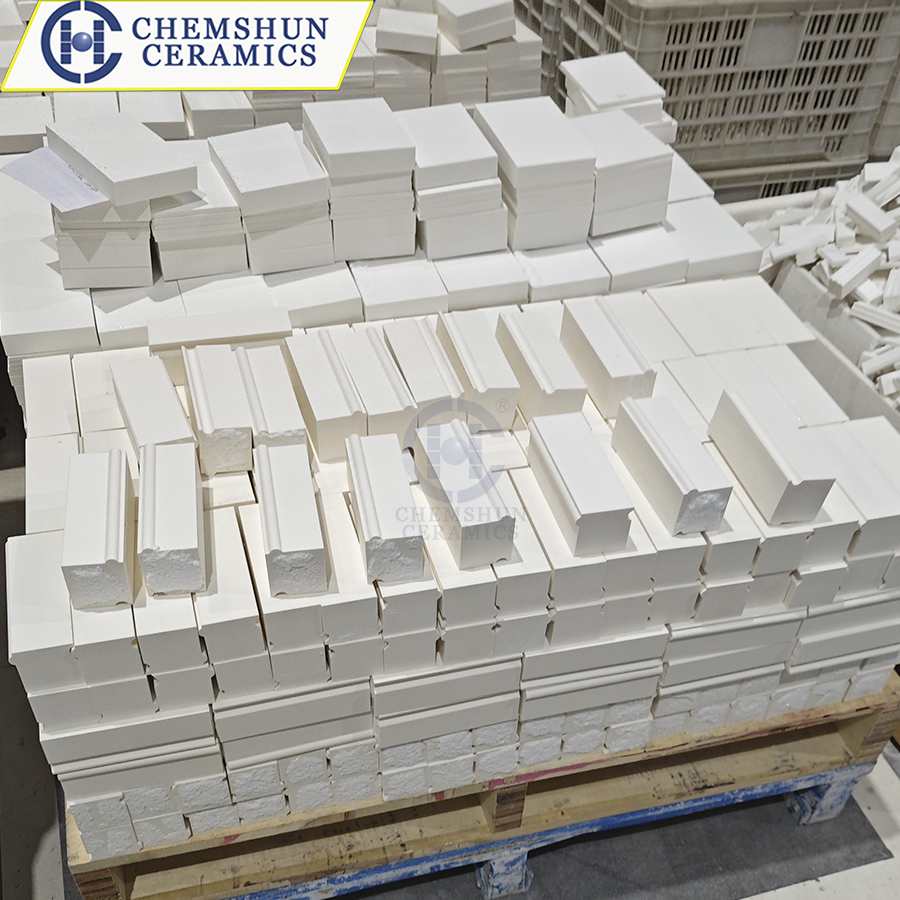
Alumina ceramic lining bricks are manufactured from high-purity alumina powder through high-pressure forming and high-temperature sintering. With a Mohs hardness of 9 and a dense microstructure, their wear resistance is significantly superior to that of ordinary steel. Under comparable operating conditions, ceramic liners deliver a longer wear life than conventional steel liners, helping to reduce replacement frequency.
This performance advantage originates from the crystalline structure and sintered density of the material itself, rather than from surface coatings or composite architectures. In other words, wear resistance is consistent throughout the brick cross-section and does not degrade rapidly due to localized wear.
Differentiated Advantages over Metal Liners
1. Chemical Stability and Contamination Prevention
Alumina ceramic lining bricks exhibit good chemical inertness and resistance to acid and alkali corrosion, remaining stable in wet grinding and corrosive slurry environments. For contamination-sensitive applications such as lithium battery cathode materials, fine ceramics, and high-purity minerals, ceramic liners do not generate iron debris or heavy metal impurities during grinding, thereby reducing a source of powder contamination from the liner side.
2. Surface Condition and Grinding Stability
Ceramic lining bricks have a smooth surface and a lower tendency for material adhesion, which helps maintain stable grinding efficiency. Compared with metal liners that gradually lose grinding performance as they deform under wear, ceramic liners exhibit a more gradual performance decline over their service life.
3. High-Temperature Resistance and Dry Grinding Adaptability
Compared with rubber liners, alumina ceramic lining bricks offer advantages in high-temperature resistance and impact resistance, making them suitable for dry grinding and medium-to-high temperature conditions without rapid aging failure caused by frictional heat from the material.
The value of alumina ceramic lining bricks lies not in replacing all liner materials, but in providing an engineering option with clearly defined performance boundaries for high-hardness materials, high-purity requirements, and continuous operation. Their material inertness, wear consistency, contamination resistance, and geometric adaptability together constitute the technical rationale for ball mill liner applications. Selection should be based on a systematic assessment of mill specifications, material characteristics, wet or dry process, and operating regime, rather than on a single hardness indicator alone.
Post time: Oct-24-2026