

Steel production involves a complete process flow, including sintering, ironmaking, steelmaking, and other stages. The high-speed conveying and transfer of solid materials such as iron ore, coke, coal powder, and steel slag are core parts of production operations. Chutes, hoppers, conveying pipes, mixing equipment, and other material handling equipment are constantly exposed to abrasive material erosion, friction wear, material adhesion, and clogging. Traditional carbon steel and wear-resistant steel equipment has a short service life, requires frequent maintenance, and causes high downtime losses, which seriously restricts continuous and efficient steel plant production. High-purity alumina ceramics, with their ultra-high wear resistance, very low friction coefficient, impact resistance, and corrosion resistance, have become a core material for upgrading wear protection in steel plant material handling equipment. They are widely used to retrofit liners in various conveying systems, significantly reducing production and maintenance costs.
Sintering and Coking Systems
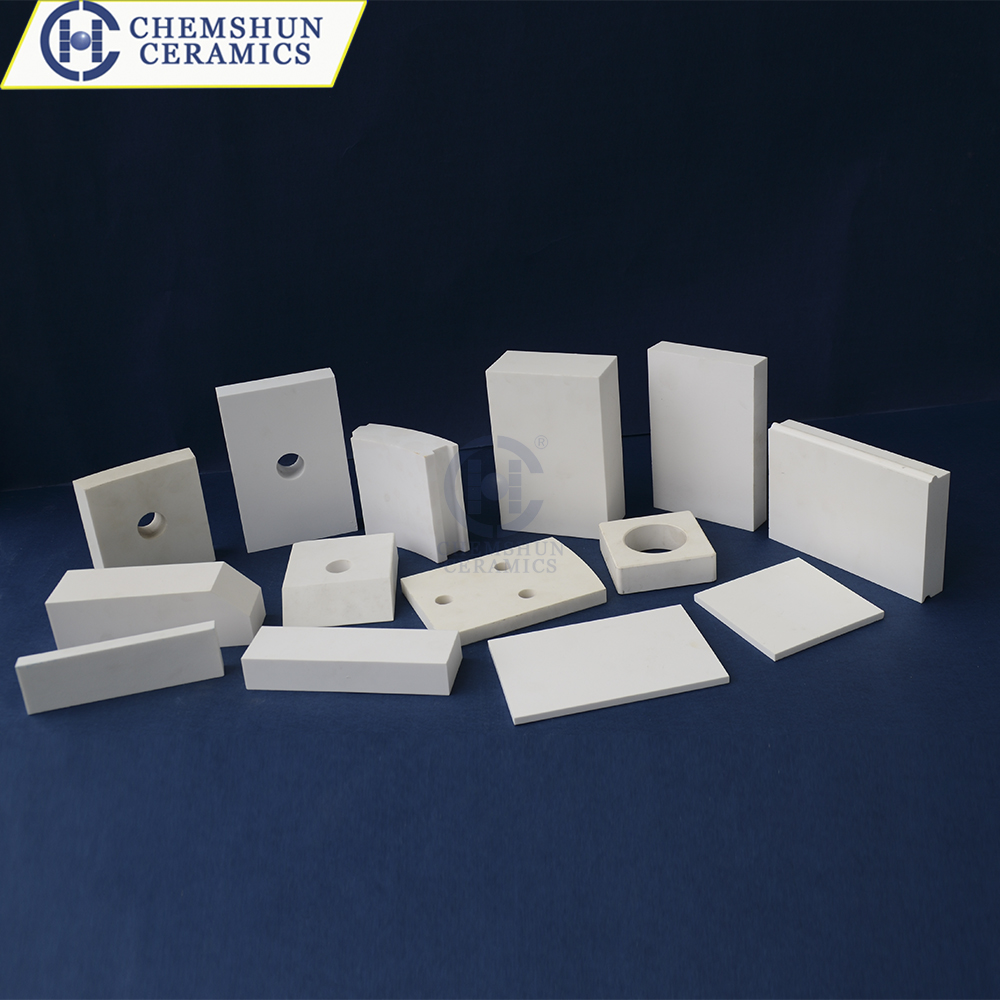
In sintering and coking systems, sinter mixers, blast furnace hoppers, and eccentric chutes are the core equipment subject to the most severe wear. During production, hard sinter and coke particles continuously strike and rub against the inner walls of the equipment at high speed. Ordinary steel liners can quickly develop wear holes, deformation, and damage, not only causing material leakage and dust pollution but also creating uneven inner surfaces that lead to material accumulation and clogging. This affects material proportioning accuracy and sintering efficiency. When K95 and K99 high-purity alumina ceramic liners and ceramic wear tiles are used as equipment liners, the root cause of equipment wear can be addressed. Alumina ceramics are much harder than ordinary wear-resistant steel, and their resistance to particle erosion and wear is more than 10 times that of carbon steel, allowing them to continuously withstand high-frequency impact and friction from hard materials. At the same time, their smooth, dense surface helps reduce material adhesion, accumulation, and caking, effectively eliminating clogging in chutes and hoppers and ensuring smooth, stable material flow. According to tests at several large steel mills, the service life of retrofitted sintering and coking conveying equipment can be extended from 3–6 months to more than 5 years, greatly reducing equipment replacement frequency.
Blast Furnace Pulverized Coal Injection Systems
In blast furnace pulverized coal injection (PCI) systems, coal powder conveying pipes and elbows are high-wear components that require frequent replacement. Coal powder particles are fine and travel at high speed, and they scour pipe inner walls at high speed over long periods. Ordinary steel pipes can show inner-wall thinning, localized perforation, and coal leakage after about 3 months of use, resulting not only in coal waste and excessive workshop dust but also in flammable and explosive safety hazards. Frequent shutdowns for inspection and pipe replacement can also seriously disrupt the blast furnace production rhythm. Wear-resistant pipes and elbows lined with alumina ceramics are ideally suited to the demanding conditions of coal powder conveying. Their excellent erosion and wear resistance can extend the service life of the pipes to more than 18 months, a sixfold increase. In addition, the ceramic liner is non-magnetic and non-stick, which can reduce coal powder conveying resistance, decrease powder buildup in pipes, improve coal powder conveying efficiency and uniformity, ensure stable operation of the blast furnace PCI system, and indirectly increase ironmaking capacity and reduce energy consumption.
Lightweight, Easy-to-Install, Maintenance-Free Wear Protection
Compared with traditional wear protection solutions, alumina ceramic liners for conveying equipment also offer the advantages of being lightweight, easy to install, and maintenance-free. Ceramic liners and wear tiles can be custom-machined to equipment dimensions and fixed with a specialized high-temperature-resistant adhesive. Installation is convenient and requires no hot work, and it does not affect the equipment’s original structure. After retrofitting, the equipment does not require frequent inspection and maintenance, greatly reducing labor and downtime losses. As the steel industry pursues cost reduction, efficiency improvement, and green production, alumina ceramics have become the optimal wear protection solution for steel plant material handling equipment, comprehensively improving the stability and economic performance of conveying systems.
Post time: Sep-20-2026