

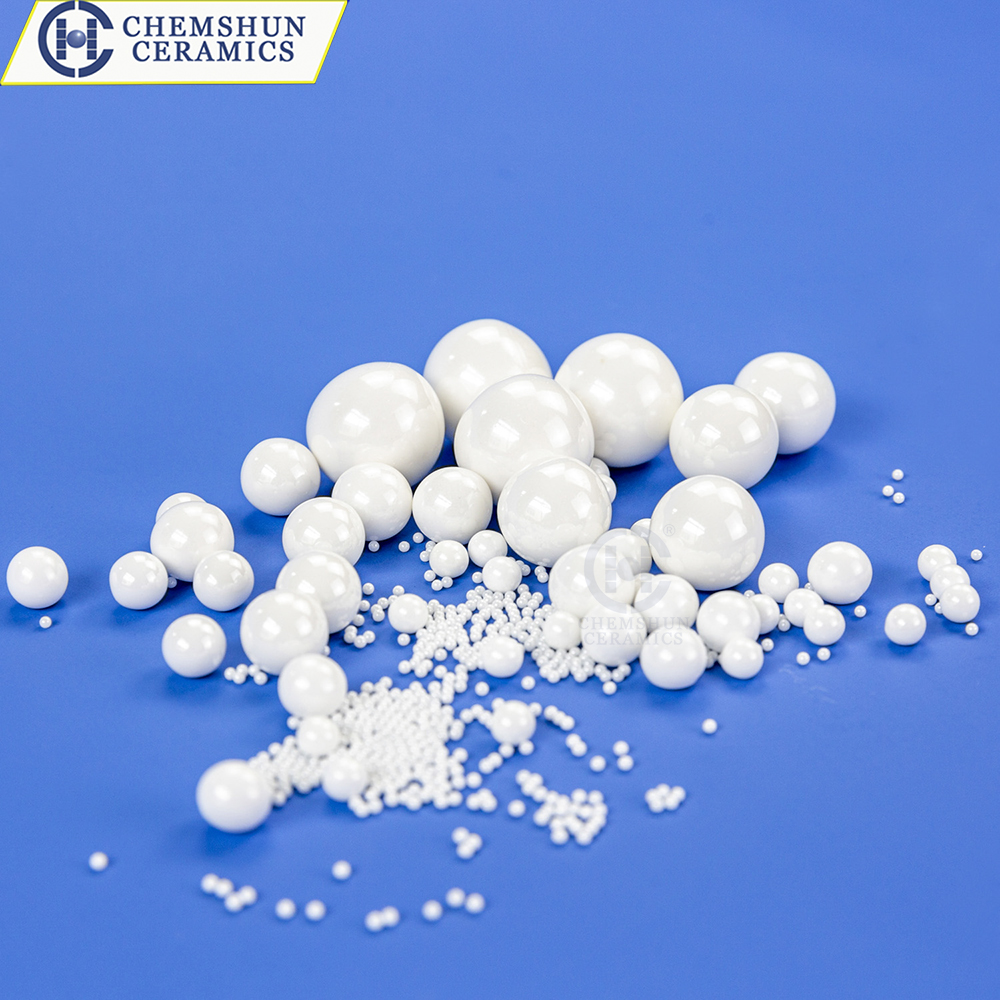
Grinding balls, with core advantages such as high hardness, excellent wear resistance, low wear rate, and strong chemical stability, can adapt to the grinding requirements of materials with different hardness levels. They are widely used in non-metallic minerals, ceramics, coatings, chemicals, electronic materials, and many other industries. Their typical application scenarios and suitability characteristics are described below.
I. Non-Metallic Mineral Processing Industry
This industry is one of the core application areas of alumina ceramic grinding balls. They are especially suitable for ultrafine grinding and fine processing of high-hardness non-metallic minerals, effectively ensuring product purity and grinding efficiency.
Quartz sand processing: As a mainstream grinding medium in the quartz sand industry, alumina ceramic grinding balls are suitable for the entire process of coarse grinding, fine grinding, and ultrafine grinding of quartz sand. In the coarse grinding stage, medium-high alumina grinding balls with a particle size of 5–10 mm are used for pretreatment and particle size reduction of quartz sand raw materials to enhance the grinding impact force. In the ultrafine grinding stage (for example, preparing quartz sand powder with D50 ≤ 1 μm), high-purity grinding balls with an alumina content of ≥99% and a particle size of 0.1–1 mm are used to reduce the introduction of impurities and meet the purity requirements of high-end products such as photovoltaic glass and electronic-grade quartz sand. These balls are suitable for ball mills, stirred mills, and other equipment.
Feldspar and kaolin processing: For non-metallic minerals such as feldspar and kaolin with a Mohs hardness of 6–7, alumina grinding balls can achieve uniform grinding and particle size control, helping to prepare ceramic body raw materials, papermaking fillers, and other products. 92% or 95% alumina ceramic balls are selected, with the fill ratio controlled at 45%–50%. They are suitable for conventional ball mills and balance grinding efficiency and cost.
Calcium carbonate and talc powder processing: In the ultrafine grinding of ground calcium carbonate and talc powder, alumina grinding balls can effectively avoid impurity contamination caused by media wear, ensuring product whiteness and purity. They are suitable for wet grinding processes and are widely used in the preparation of fillers for plastics and rubber.
II. Ceramics and Refractories Industry
In the production of ceramics and refractory materials, there are strict requirements for the uniformity, fineness, and impurity content of raw material grinding. Alumina ceramic grinding balls are ideally suited to the grinding needs of body raw materials, glazes, and refractory materials.
Ceramic body and glaze grinding: Alumina grinding balls are used for the mixing and grinding of ceramic raw materials (such as clay, quartz, and feldspar) to uniformly refine raw material particles and improve body density and glaze gloss. Different particle sizes are selected according to the grinding stage: 3–8 mm grinding balls for coarse grinding and 1–3 mm grinding balls for fine grinding. High-end ceramic products preferably use high-purity alumina grinding balls to avoid affecting glaze color and product performance.
Refractory material processing: For the grinding of refractory raw materials such as corundum and mullite, alumina grinding balls, with their high wear resistance and high-temperature resistance, can operate stably in high-temperature grinding environments. They help produce high-strength, high-temperature-resistant refractory bricks, refractory castables, and other products, and are suitable for both dry and wet grinding processes.
III. Coatings, Inks, and Pigments Industry
This industry requires ultrafine dispersion and uniform mixing of pigments and fillers. Alumina grinding balls can effectively improve dispersion, ensure color uniformity and stability of coatings and inks, and will not introduce impurities that affect product performance.
Coating grinding: Alumina ceramic grinding balls are used for the grinding and dispersion of water-based and solvent-based coatings, refining and dispersing raw materials such as titanium dioxide, lithopone, and color paste, thereby improving the hiding power, adhesion, and leveling of coatings. Grinding balls with a particle size of 0.5–2 mm are selected and are suitable for sand mills and stirred mills. They operate stably in media environments with pH = 4–10, avoiding corrosion and wear.
Ink and pigment processing: In the preparation of inks, color pastes, and pigments, alumina grinding balls can achieve ultrafine grinding of pigment particles, ensuring uniform color and strong tinting strength. They also have a low wear rate and will not affect ink transparency or purity due to media loss. They are suitable for high-speed sand mills and other equipment.
Post time: Nov-12-2026