

Alumina ceramics offer high hardness and excellent wear resistance, but their brittleness limits their standalone use at impact points involving large bulk materials. Ceramic composite plates are modular solutions that combine alumina ceramics with steel plates through high-strength structural layers. They are one of the fastest-growing product forms in current wear-resistant upgrades for industrial and mining applications, effectively balancing wear resistance, impact resistance, and ease of installation.
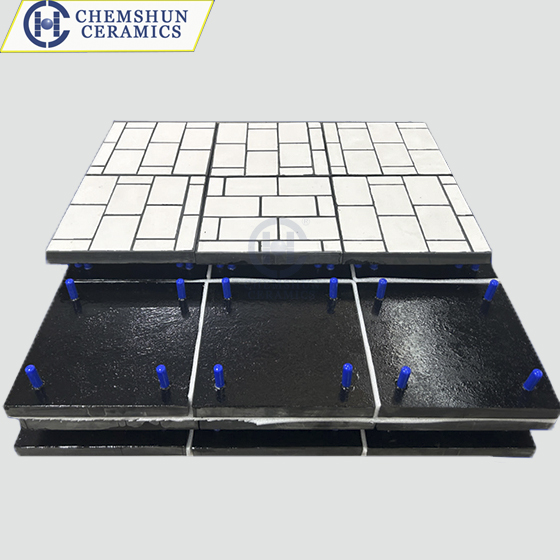
Ceramic composite plates are not simply ceramic tiles bonded to steel plates. A mature composite structure consists of a three-layer system: a top alumina wear-resistant ceramic layer, an intermediate buffer transition layer, and a bottom load-bearing steel base plate. The transition layer provides stress buffering, absorbs the impact energy of materials, prevents impact stress from being transmitted directly to the ceramic, and reduces ceramic cracking and chipping. The base plate provides overall rigidity, facilitates welding and bolted fixing, and allows direct replacement of existing carbon steel liners, making retrofit construction convenient.
The modular design also brings O&M advantages. Once a traditional integral liner is locally damaged, the repair workload is large and downtime is long. Ceramic composite plates use a segmented design, so only the single plate at the worn or damaged location needs to be replaced, greatly shortening maintenance time and reducing production losses. In addition, plate specifications can be customized on demand; curved and specially shaped chutes, elbows, and hopper corners can be mold-processed to fit non-standard equipment.
When selecting products, the application boundaries of composite plates must be distinguished. In medium-to-low impact and continuous erosion scenarios, standard ceramic composite plates offer outstanding cost-effectiveness. At points with very large ore blocks and high-frequency high-impact, it is also necessary to optimize the ceramic block shape, add impact-resistant structures, and even adjust the ceramic formula to improve toughness. If the operating conditions are misjudged, ceramic block detachment can still occur even with composite plates.
Compared with high-manganese steel and wear-resistant cast steel, ceramic composite plates have a higher initial purchase cost, but their wear life is several times longer. Over the long term, they reduce spare parts procurement, downtime maintenance, and labor costs, showing a clear total cost of ownership advantage. In technical upgrade projects in the steel, mining, and cement industries, more and more operations are shifting from “frequent liner replacement” to alumina ceramic composite lining solutions.
Post time: Nov-20-2026