

Alumina ceramic lined elbows resist erosive wear in pneumatic and slurry piping. Learn how α-Al₂O₃ liners extend elbow service life in power, mining, and cement plants.
Why Do Pipe Elbows Wear Faster Than Straight Sections?
Pipe elbows are the most frequent wear-related failure point in solids-handling piping systems. The geometry of the bend forces the flowing medium to change direction. Solid particles carried by the fluid cannot follow the streamline due to inertia and instead impact the outer wall of the elbow at an oblique angle. This localized, repeated particle impingement produces erosive wear that is substantially more severe than the sliding abrasion occurring in straight pipe runs.
Key variables that govern elbow wear rate include particle velocity, particle size, pipe diameter, and bend radius ratio. Higher inlet velocities and larger particle mass flow rates accelerate material loss. In pipelines with multiple elbows in series, the second and subsequent elbows often experience more concentrated erosion because particles have already been accelerated and redistributed by the preceding bend. Carbon steel elbows in high-wear duties such as pulverized coal conveying or ash handling can develop wall thinning and leakage within weeks to months of service.
How Does an Alumina Ceramic Liner Solve the Elbow Wear Problem?
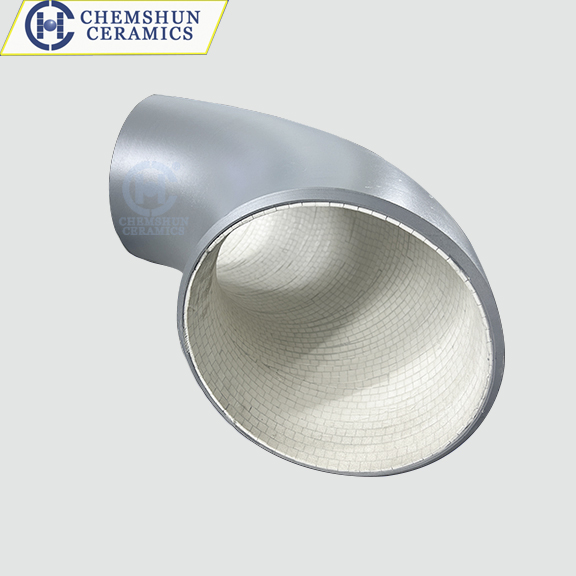
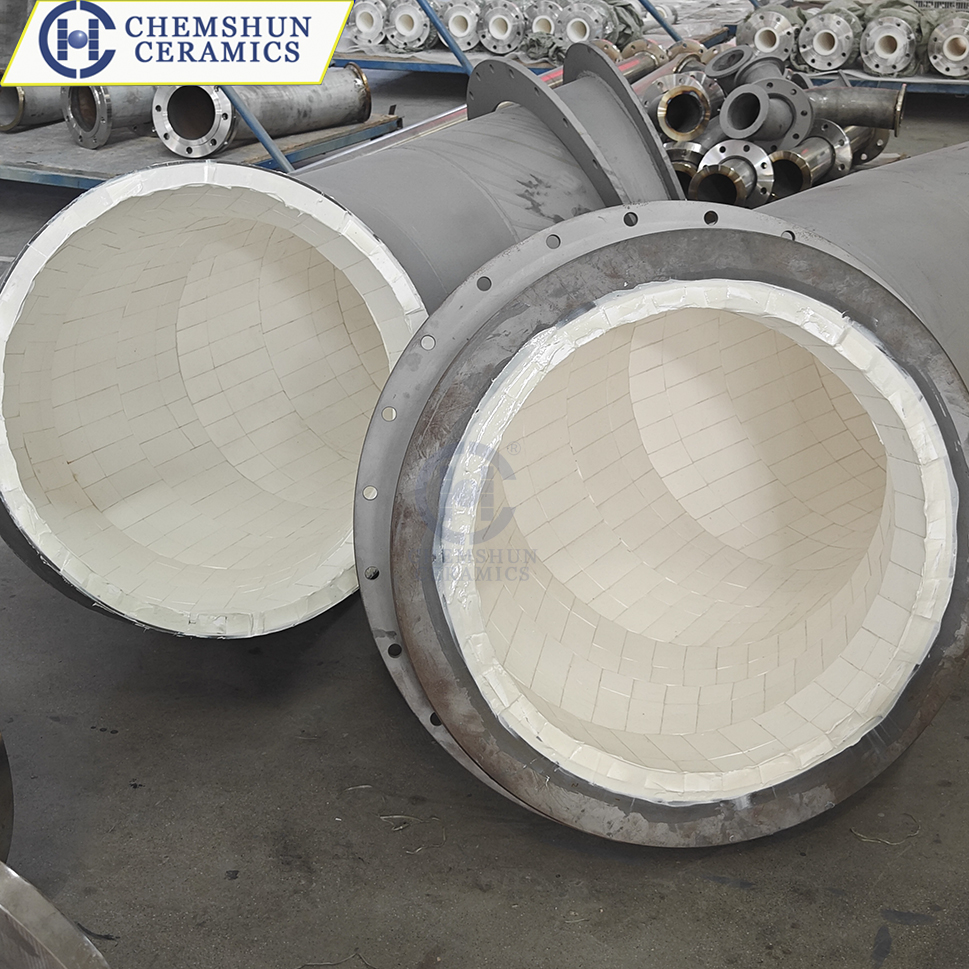
The alumina ceramic lined elbow addresses wear at the material level rather than through increased wall thickness alone. A dense α-Al₂O₃ corundum ceramic layer is bonded to the inner surface of a steel elbow via an intermediate transition layer. The ceramic provides wear resistance through its high hardness, while the steel shell carries structural loads and external mechanical stresses.
Alumina ceramic achieves a Mohs hardness of 9, second only to diamond, and a Rockwell hardness of HRA 80–85 or higher depending on grade. This hardness level is substantially greater than that of high-chromium cast iron or manganese steel commonly used in wear-resistant piping. Because the ceramic resists indentation and cutting by hard particles, material removal occurs at a much lower rate under the same erosive conditions.
Where are Alumina Ceramic Lined Elbows Applied?
Alumina ceramic lined elbows are specified in piping systems where abrasive particles are conveyed at velocity and where elbow replacement frequency directly affects operating availability. Principal application areas include:
Pulverized coal and ash handling in power generation. Coal-fired power plants use ceramic lined elbows in pulverized coal piping, ash conveying lines, and flue gas desulfurization circuits. The ceramic lining reduces wear from high-velocity coal and ash particles, lowering maintenance frequency and unplanned downtime.
Mining and mineral processing. Slurry transport, tailings lines, and cyclone feed piping carry high concentrations of hard solids. Alumina ceramic lined bends resist the combined effects of abrasion and erosion in these duties.
Cement and building materials. Raw meal and cement conveying systems involve abrasive particulate flow at elevated temperatures. Ceramic lined elbows maintain wear resistance where metal elbows degrade rapidly.
Metallurgy and steelmaking. Blast furnace pulverized coal injection lines and sinter conveying systems use ceramic lined elbows to extend service intervals in continuous high-wear positions.

Post time: Oct-19-2026