

In cement production, equipment such as material conveying pipes, separator housings, cyclones, and chutes endure prolonged high-velocity impact and sliding wear, leading to rapid loss of metal substrates and increased downtime maintenance costs. The application of wear-resistant alumina ceramic lining significantly extends service life. This lining is formed via high-temperature sintering, with an alumina content of no less than 92%, bulk density ≥3.60 g/cm³, Rockwell hardness (HRA) above 85, and a wear volume below 0.1 cm³ (tested according to GB/T 8489-2006).
Compared to conventional wear-resistant steel plates (e.g., NM400), alumina ceramic lining exhibits approximately 5–8 times higher wear resistance, along with a low surface friction coefficient (approx. 0.2–0.3 under dry conditions), reducing material adhesion and blockage risks. Ceramic tiles are fixed to the equipment inner wall using epoxy resin or inorganic adhesive, with an operating temperature range of -50°C to 300°C and short-term tolerance up to 500°C. Under typical cement plant conditions, the ceramic lining extends chute service life from 6 months to over 36 months.
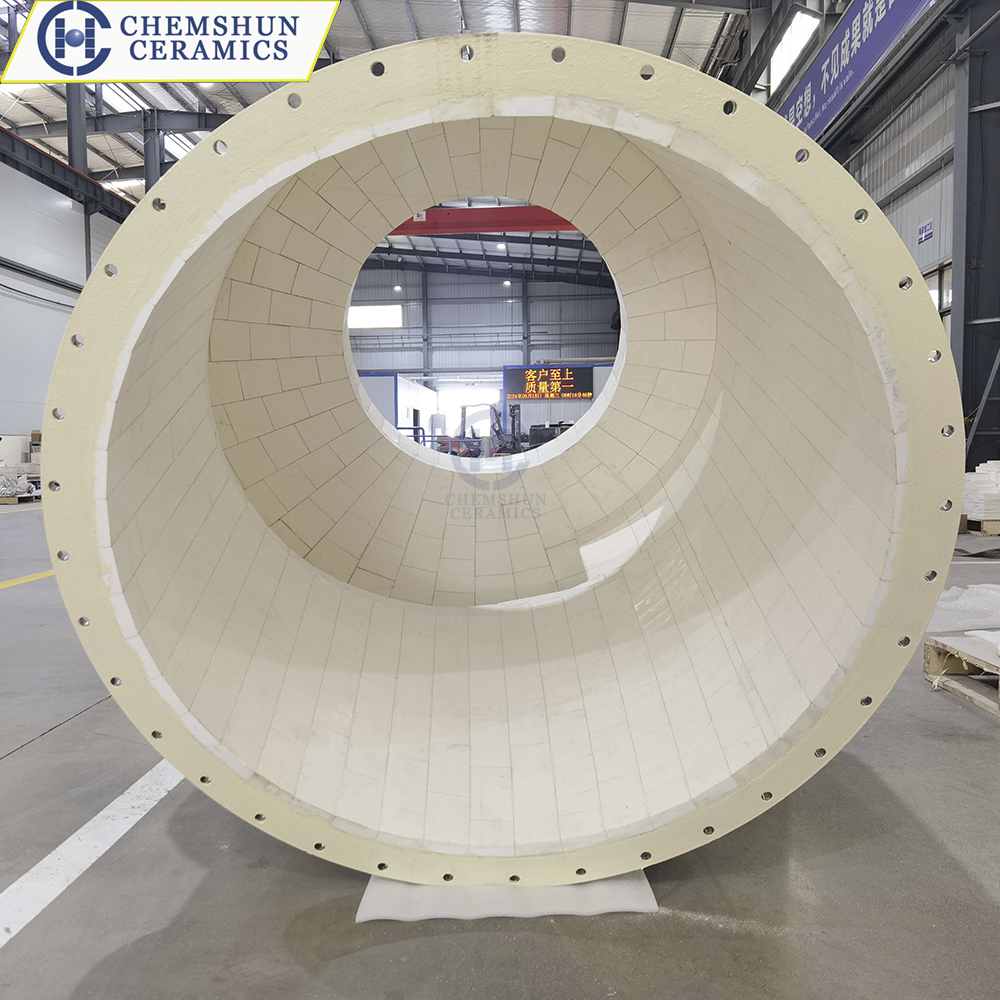
This lining has been successfully applied to critical components such as mill feed chutes, separator guide vanes, cyclone cones, and clinker conveying pipes in cement plants. Field data indicates that under average material particle size of 30 mm and linear velocity of 15 m/s, after 12 months of continuous operation, the wear depth on ceramic tile surfaces is only 0.2–0.5 mm, and equipment maintenance intervals are extended to four times the original duration. Available in modular ceramic plates or mosaic tile patches, the lining adapts to equipment with varying curvatures and structural shapes.
Promoting wear-resistant alumina ceramic lining in cement engineering equipment effectively reduces spare parts consumption and downtime losses, improving overall operating rates of production lines. During installation, ensure the substrate surface is clean and free of oil; adhesive curing time should be no less than 24 hours (at 25°C). For impact angles greater than 45° at material drop points, a buffer layer is recommended to further optimize impact resistance. This technology has been incorporated into multiple wear-protection design standards within the cement industry.
Post time: Apr-13-2026