

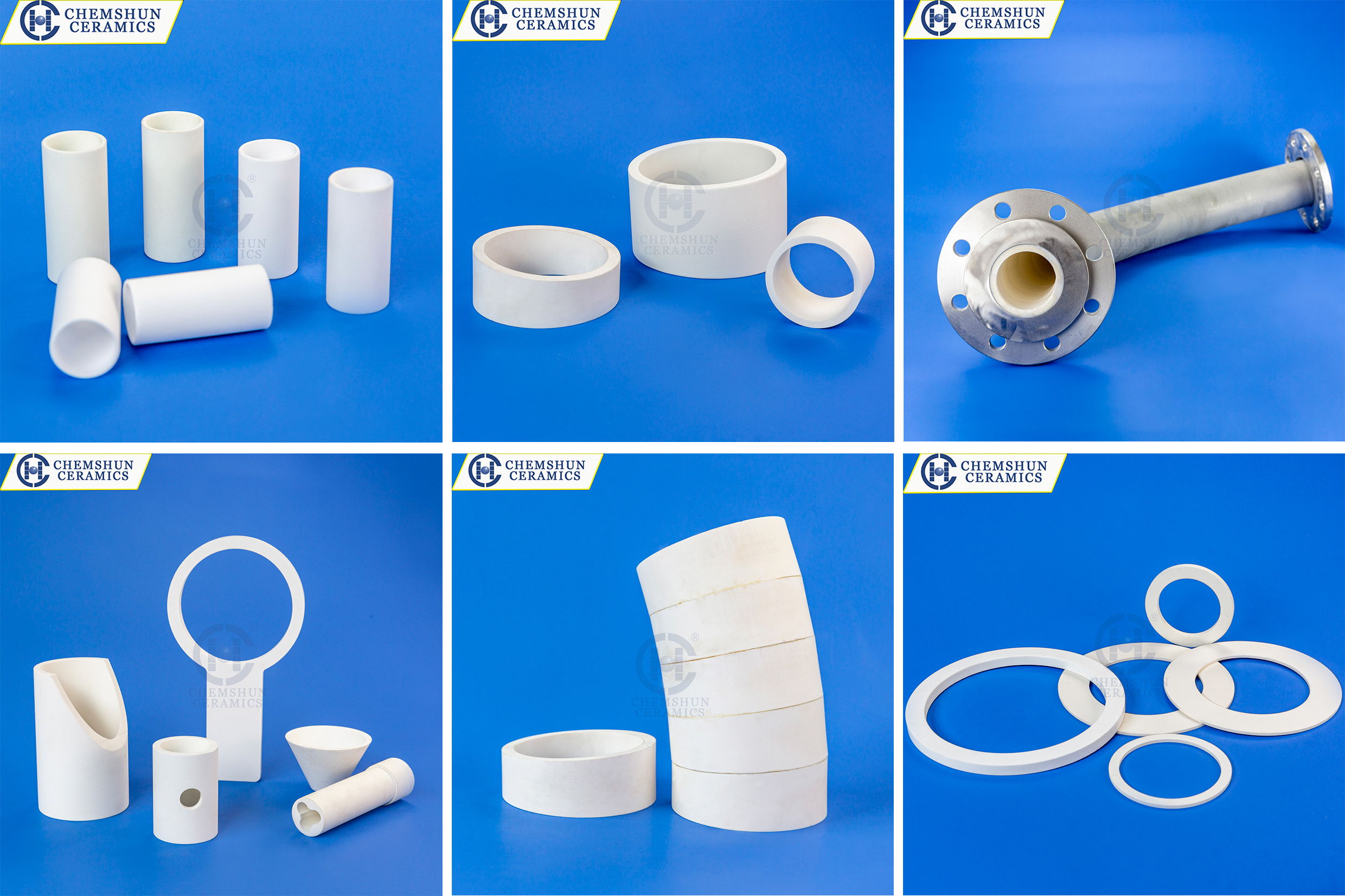
In industries where conveying abrasive materials is a daily operational reality, premature pipeline failure is not just a maintenance headache—it’s a direct hit to the bottom line. Our high-purity alumina wear-resistant ceramic pipes are engineered to solve this exact challenge. With an alumina (Al₂O₃) content exceeding 95%, these pipes exhibit a Rockwell hardness of HRA 85-90, second only to diamond. This extreme hardness translates to exceptional resistance to sliding abrasion and particle impact, effectively extending service life by 5 to 10 times compared to traditional hardened steel pipes. Crucially, the exceptional hardness is matched by a low density of approximately 3.6 g/cm³, making the ceramic piping system significantly lighter than metallic alternatives, thereby reducing structural load and installation costs without sacrificing durability.
The advanced manufacturing process is integral to the pipe’s superior performance. Each liner is formed through an isostatic pressing or high-pressure extrusion process, followed by precision firing in a high-temperature kiln at 1500°C–1700°C. This controlled sintering yields a dense, homogeneous microstructure with minimal porosity, effectively eliminating weak points that could initiate wear. The ceramic liners are then bonded to a tough steel outer casing using a specialized high-strength, temperature-resistant epoxy resin. This composite construction leverages the ceramic’s hardness for wear resistance and the steel’s toughness for mechanical protection, ensuring reliable performance under conditions of thermal shock and high-frequency impact. The inner surface of our ceramic pipes maintains a smooth finish with an absolute roughness (Ra value) of less than 0.4 μm, a critical feature that minimizes frictional resistance, promotes laminar flow, and significantly reduces material hang-up, making these pipes indispensable for pneumatic and hydraulic conveyance systems.
The real-world applicability of our alumina ceramic pipes spans a vast array of high-wear scenarios. In coal-fired power plants, they are the trusted choice for pulverized coal injection (PCI) lines and fly ash pneumatic conveying systems, routinely outperforming basalt and hard-facing steel by a significant margin. The mining and mineral processing sector relies on them for transporting dense slurries such as iron ore concentrate, copper tailings, and silica sand, where the pipe’s resistance to both wear and chemical corrosion from acidic or alkaline slurries is paramount. Furthermore, in the cement, steel, and chemical fertilizer industries, these pipes ensure operational continuity in critical loops subjected to high-velocity particle impingement. Ultimately, investing in our alumina ceramic pipes is a strategic decision—replacing reactive maintenance with proactive reliability, drastically reducing unplanned downtime, and delivering a lower total cost of ownership over the entire asset lifecycle.
Post time: Jul-14-2026