

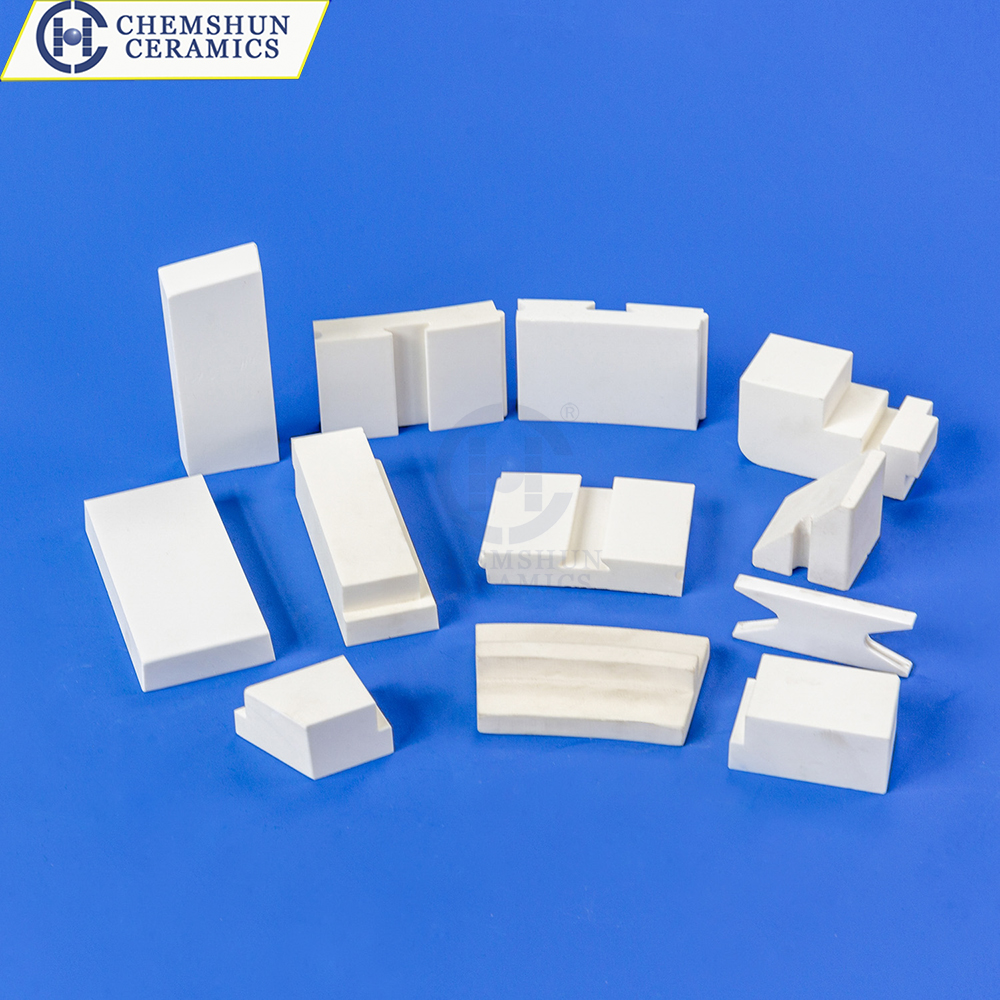
Wear-resistant alumina ceramic is an advanced industrial ceramic material primarily composed of high-purity alumina (Al₂O₃). It has become a key material for addressing severe wear, corrosion, and high-temperature conditions due to its exceptional hardness, wear resistance, and chemical stability. Compared to traditional metallic wear-resistant materials, it significantly extends equipment service life and reduces maintenance frequency and costs across numerous industrial sectors, serving as an indispensable solution for industries ranging from energy and metallurgy to high-end manufacturing.
Its exceptional performance is based on precise physical and chemical data. The Rockwell hardness (HRA) of alumina ceramic can reach 80-90, with a compressive strength exceeding 850 MPa. Professional tests indicate its wear resistance is 266 times that of manganese steel and 171.5 times that of high-chromium cast iron. Regarding temperature resistance, its long-term service temperature can reach 300°C, and it can withstand acid and alkali corrosion within a pH range of 3 to 12. These properties enable it to operate stably in high-impact, high-wear, and corrosive environments, for instance, extending the service life of coal powder conveying pipelines by over 10 times.
The performance of wear-resistant alumina ceramic benefits from precise control of the entire process from raw materials to sintering. Firstly, the raw alumina powder undergoes superfine grinding, with particle size typically controlled below 1 micron, ensuring high purity and uniform particle size distribution. Primary forming processes include dry pressing and isostatic pressing, the latter imparting more uniform density to the green body. Finally, the green body is sintered at approximately 1700°C, forming a dense microcrystalline structure, with material density reaching over 95%. Composite formulations, such as adding zirconia (ZrO₂), can further enhance its impact resistance and toughness.
This material is widely used across multiple industrial sectors. In the energy and environmental protection industries, it is used in coal powder pipelines of thermal power plants, and in classifiers and cyclone cones of cement plants, increasing equipment service life by 3 to 5 times. In the metallurgy and mining industries, ceramic liners installed in blast furnace coal injection pipes and dust removal pipelines effectively resist highly abrasive media like iron ore powder, reducing annual maintenance costs by up to 60%. Furthermore, ultra-high purity (e.g., 99.7%) alumina ceramics are also utilized in high-end manufacturing fields such as semiconductor wafer polishing.
Post time: Dec-19-2025