

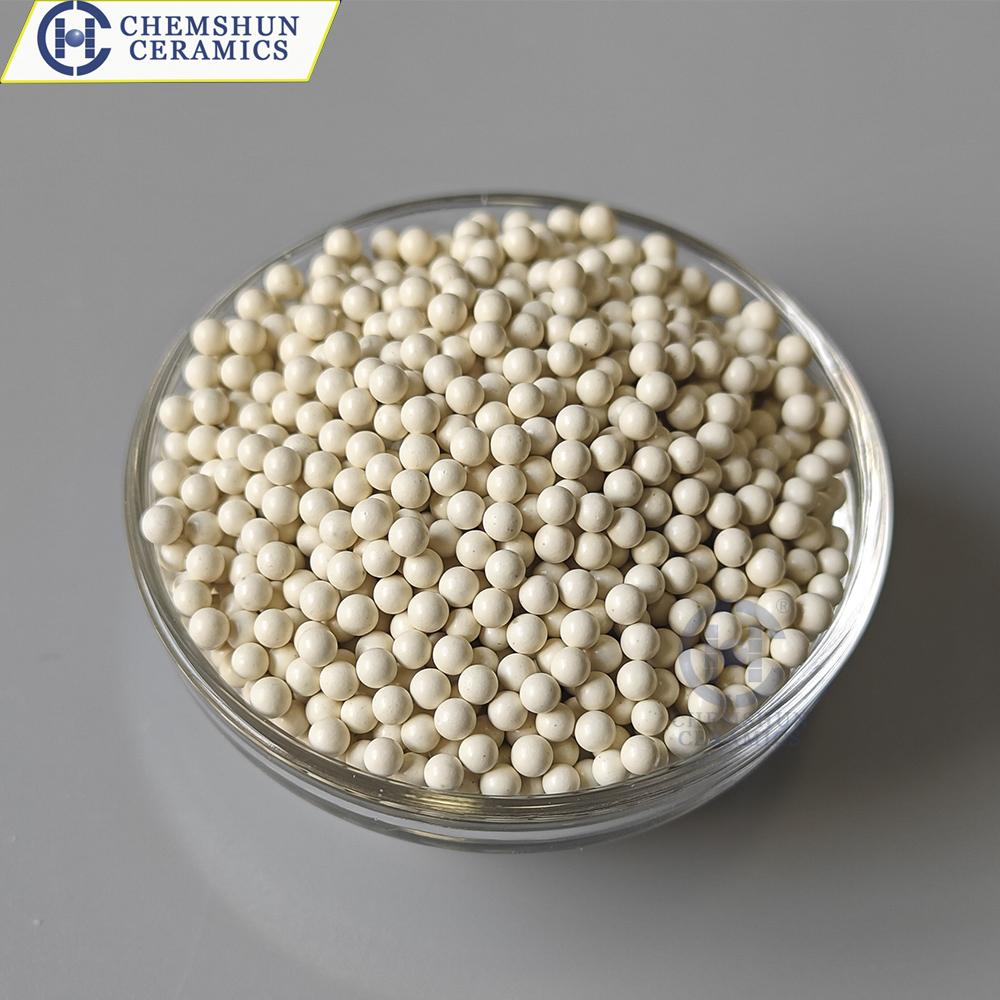
Zirconium silicate ceramic grinding balls are grinding media produced from zirconium silicate (ZrSiO₄) via high-temperature sintering, with a zirconium dioxide (ZrO₂) content typically ranging from 55% to 65% and a silicon dioxide (SiO₂) content of 30% to 37%. Their true density is approximately 4.0–4.1 g/cm³, and bulk density ranges from 2.5 to 2.7 kg/L. Mohs hardness is between 7.2 and 8.0, and Vickers hardness exceeds 900 HV. The wear rate is ≤0.05 kg per ton of slurry processed, and sphericity is ≥96%, ensuring consistent performance in grinding equipment.
Zirconium silicate beads are widely used in grinding and dispersion processes for low-to-medium viscosity slurries, including paints, coatings, inks, pigments, agricultural chemicals, calcium carbonate, kaolin, and titanium dioxide. They are compatible with various grinding equipment such as stirred bead mills, ball mills, sand mills, and high-speed dispersion mills. Compared to high-density zirconia beads, zirconium silicate beads offer a more cost-effective solution with moderate density and adequate wear resistance for conventional grinding applications. Their sintered, non-porous microstructure minimizes breakage and reduces contamination of processed materials.
With a balanced combination of density, hardness, and cost, zirconium silicate ceramic grinding balls are established as a standard medium for a wide range of industrial milling operations. For applications requiring higher density or extremely low contamination levels, yttria-stabilized or ceria-stabilized zirconia beads (density 6.0 g/cm³, wear rate ≤0.01‰) are recommended. The selection of appropriate grinding media should be based on material characteristics, equipment parameters, and target particle size distribution to achieve optimal grinding efficiency and operational economy.
Post time: Apr-18-2026